About me
I started as a full-stack engineer, moved into business partnership, and chose product management because it was the role where all of it (the engineering, the business thinking, the user obsession) could work as one.
What that arc gave me:
I've designed databases, built backend systems, and written code. I can sit with engineering and know what's actually hard.
Years in business partnership taught me to connect user pain to the numbers that matter: retention, revenue, activation.
I spent thousands of hours with users and stakeholders with competing priorities. The real product work is in the why behind what people say, not the ask itself.
Curious about my journey? Watch how Impact, Influence, and Curiosity shaped my career arc →
I’m now a PM focused on AI-native products (two shipped from 0→1), working at the intersection of fast-moving technology and real user problems.
Why AI Product Management?
Every so often, a new capability changes not just what we can build, but how problems get solved entirely.
GPS didn't improve maps. It made Uber and Airbnb possible. The technology unlocked a new class of solutions that simply didn't exist before.
LLMs are that kind of shift. The same problems we were solving before can now be solved in fundamentally different ways: faster, more personalized, more adaptive. That's not an incremental improvement. That's a new design space.
And here's what I find most interesting about this moment:
When the barrier to building drops, the most important question is knowing what to build and why.
That's where I work. Not just using AI as a feature, but thinking clearly about where it genuinely changes the outcome for a user, and where it doesn't.

Podcasts I listened to were mostly an hour long, but the transcripts were available. Last year I built a simple n8n flow to summarize them: not because it was hard, but because I wanted to see how fast I could make something actually useful with these tools.
She's the kind of kid who gets excited by challenges and new gadgets. When she got a new MacBook, I built her a browser-based subtraction app instead of handing her a worksheet: pink UI, medals, a scoreboard, and difficulty that adapts as she improves. Under 30 minutes in Cursor. Scrappy code, not something I'd show an engineer. But she opened the laptop and practiced. That was the whole point.
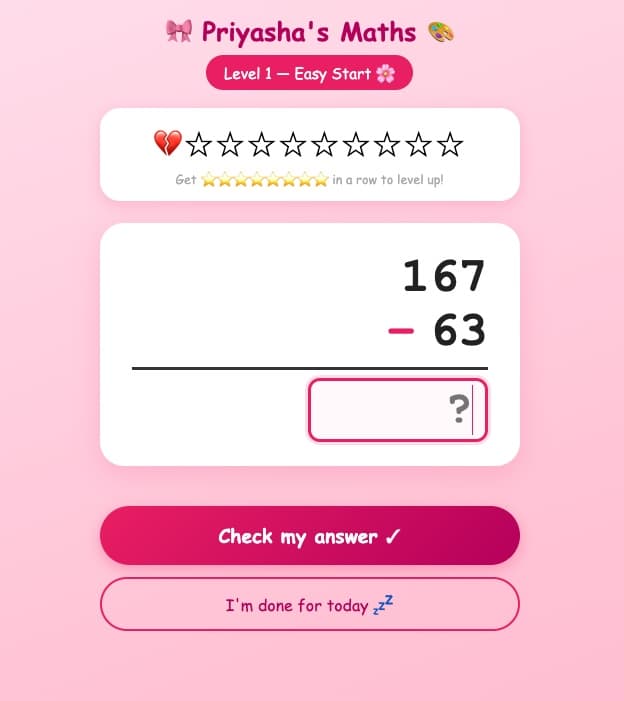
The math app got me thinking. The adaptive difficulty is just a small program, no LLM needed. But generating story problems? That's where a model actually earns its place. I'm exploring running Gemma 4 on-device to add that layer. On-device because calling an API for something I built for my daughter: the cost math doesn't make sense.
This is also where I crystallized something I keep coming back to: not every problem needs an LLM. The ones that can be solved programmatically, should be.
Built across four AI tools. The full story (what I used, where it helped, where it got in the way) is its own case study.