The Apple and Claude Code
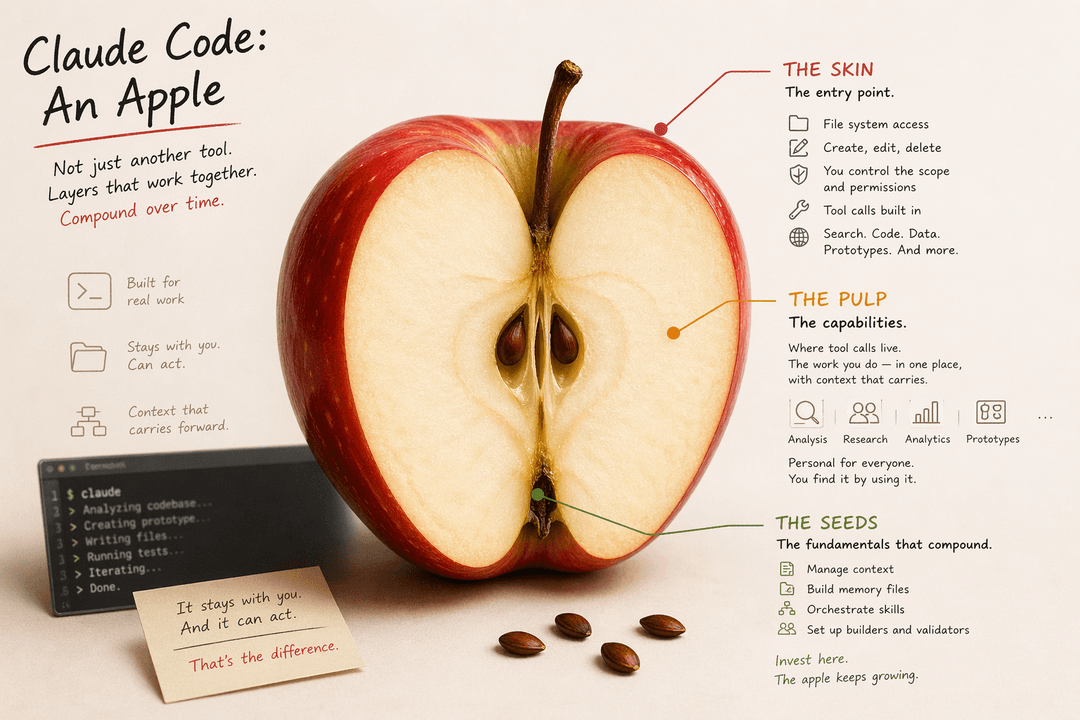
One evening my sister and I were doing what people in tech do: comparing notes on the tools we're currently using. She was walking me through Antigravity and how she uses it alongside her Google Workspace setup. Then it was my turn to explain Claude Code.
I didn't reach for a technical comparison. Something else came out: an apple.
She gave me that look. I kept going anyway.
The skin: the entry point
The skin is thin, but it's what tells you this isn't like everything else on the table.
For Claude Code, that's file system access. Unlike browser-based chat tools, it has context of your underlying file system. It can create files, edit files, delete files. And the power isn't just that it can do these things. The power lies in the control you give it. You decide the scope. You set the permissions. Tool calls are built in (search the web, run code, query data, build a prototype), all without switching context.
I realized this after hitting the ceiling with browser chat one too many times. You paste context, get an answer, the conversation ends, you start over. Claude Code isn't a smarter chatbot. It stays with you. And it can act.
The pulp: the capabilities
Once you get past the skin, there's a lot in there.
This is where tool calls live: inbuilt actions Claude Code can take on your behalf. As a product manager, my pulp looked like: competitive analysis, synthesizing user research, product analytics, prototypes. Things that used to scatter me across five different tools, now in one place with context that carries forward.
For an engineer it might be their entire codebase. For a leader, synthesizing what their team is building. The pulp is personal. You find it by using it.
The seeds: the fundamentals that compound
At the center are the seeds. And here's the thing about seeds: they grow new apples.
But they're also the easiest thing to miss. Because the pulp is a lot. The first time you watch Claude Code write hundreds of lines of code in seconds, generate an entire file structure, iterate on its own output in real time. There's an adrenaline rush to it. It's genuinely exciting. And that excitement is exactly what makes you blow past the seeds.
Just like eating an apple and throwing the seeds away without noticing. You got what you came for. The rest felt like scraps.
The seeds of Claude Code are: how you manage context, how you build memory files, how you orchestrate skills, how you set up builders and validators. Unglamorous. Easy to skip. But the more you invest in them, the better your next project goes. Sharper agents. Cleaner workflows. The apple keeps growing.
My sister nodded. Then said something like, it's layered, same way we think about stacking tools, just differently. We ended up talking for another hour.
The apple wasn't planned. It just came out.