From product instinct to stakeholder alignment in an afternoon
Personalized home screen, built from existing data, prototyped in two hours, shipped after one feedback round.
Loft's home and library screens were identical: both just showed a flat list of bookmarks. The original design included a recommendation engine that never made it to MVP, so engineering defaulted to a plain list. Two screens, same thing.
The question became: what makes the home screen feel personal and useful using only data that already exists, without significant engineering effort?
With those constraints in place, the question shifted: what can we surface that adds the most value to a user, using the lightest possible logic?
I brainstormed by connecting two things: what users genuinely want when they come back to a bookmark app, and what engineering can build with simple programmatic logic. My technical background helped here: I knew which ideas would need real ML or infrastructure, and which were just counts, sorts, or lists.
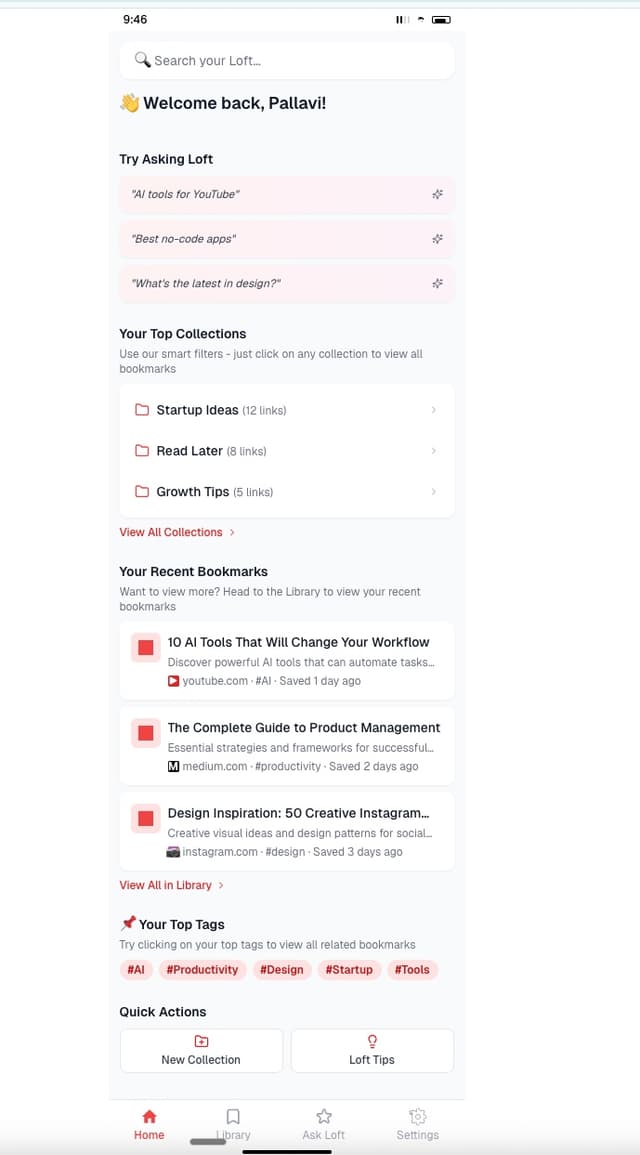
The layout surfaced five things, each picked by that two-sided test:
- Ask Loft - a natural-language search prompt at the top of the screen. For new users with no bookmarks yet, this makes the screen useful on day one and nudges them toward a key behavior shift.
- Top collections - top 3 by bookmark count, showing where their attention actually lives
- Recent bookmarks - the last few saves, so users come back to read what they added
- Top tags - a quick reflection of their own reading patterns, surfacing themes they didn't always realize were trending
- Quick actions - new collection shortcut and Loft tips
Each was just a count, a sort, or a list. No new backend endpoints, no LLM calls. Two hours in Lovable and V0 turned the layout into a clickable prototype, shippable in a day. The trade was deliberate: maximum perceived personalization for the lightest possible engineering.
A screenshot alone doesn't move a team. I recorded a short walkthrough video and paired it with a lean PRD: the reasoning behind each section, what it replaces, and edge cases for new users with no bookmarks yet. Both shared together so the team saw the idea and the thinking at once.
One round of feedback, one iteration. The designer applied the full design system and engineering shipped it. It's live today as Loft's home screen.
The prototype wasn't the deliverable. It was the tool that made the decision possible without long back-and-forth, multiple review meetings, or asking engineering to build anything speculative first.